
Choosing a coffee packaging bag looks like a single buying decision and turns out to be three decisions stacked on top of each other: what the bag has to protect, which format suits the shelf it will sit on, and which laminate can deliver that protection at a price your roast can carry. Get the order wrong and you either pay for barrier you do not need, or lose freshness you cannot get back.
1. Start with what the bag has to protect
Roasted coffee is one of the more demanding products to pack. It releases carbon dioxide for days after roasting, its aromatic oils oxidise on contact with oxygen, it absorbs moisture and ambient odours easily, and light accelerates the decline. Whole bean coffee is forgiving compared with ground coffee: grinding multiplies the surface area, so ground coffee stales far faster and needs a stronger barrier to reach the same shelf life.
Degassing and the one-way valve
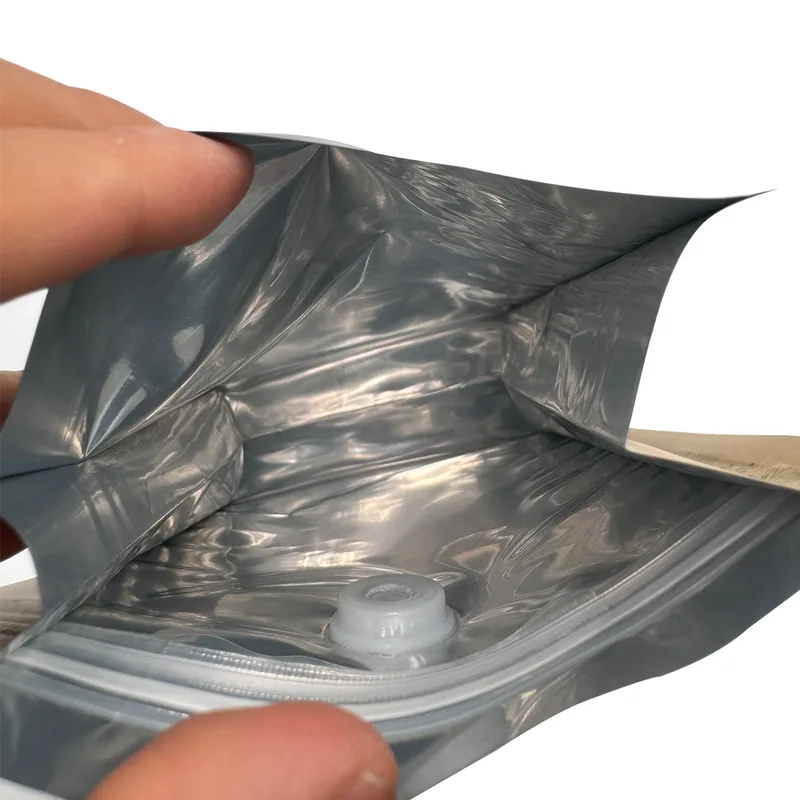
A one-way degassing valve lets carbon dioxide escape while keeping oxygen out. Without one, gas builds up inside a sealed pack and you get a pillow, a swollen bag, or a seam that fails in transit, which is why freshly roasted coffee is almost always packed with a valve. A pinhole is not a valve: it vents gas in both directions and lets oxygen in with it.
Oxygen, moisture and light
Oxygen drives oxidation, moisture costs you aroma and crispness, and light degrades the oils. A foil or metallised layer handles all three at once, which is why foil laminates remain the default for coffee even though they are not the cheapest film available.
2. Pick the format before you pick the material
Format decides how the bag behaves on a retail shelf, in an export carton and in the customer's hand, and it decides how much of your budget goes into material rather than print. The three formats below cover most coffee sold in retail and food service.
Flat bottom pouches
Flat bottom pouches stand square on the shelf, carry print on five faces and stay stable at 500 g and 1 kg fills. They are the format most specialty roasters move to as volume grows, and the one buyers most often ask for by name.
Side gusset bags
Side gusset bags are the traditional cafe and bulk format: narrower, more efficient to ship and usually cheaper per unit at the same fill weight. If you sell 1 kg bags through wholesale or food service, they usually win on cost.
Stand up pouches
Stand up pouches are the flexible middle ground: lighter than a flat bottom, with better shelf presence than a side gusset, and available with a resealable zipper for 250 g and 340 g retail packs.
3. Match the laminate to the shelf life you promise
Once the format is fixed, the laminate becomes a shelf life decision rather than a design preference. Choose the structure against the number of months you intend to print on the pack, not against the cheapest price per thousand.
PET/AL/PE laminates
A polyester / aluminium foil / polyethylene laminate is the workhorse structure for coffee. The foil layer blocks light and oxygen, the inner polyethylene layer gives a strong clean heat seal, and the outer polyester carries the print and protects the foil. It suits whole bean packed for retail distribution and long dated export orders.
Kraft paper laminates
Kraft paper looks warm and sells well, but paper on its own is not a barrier: it has to be laminated to PE or foil to keep moisture out. Printed kraft over a foil core is a common compromise and works well for brands whose identity leans on a paper look.
Compostable films
Compostable films, whether PLA based or paper based, have improved considerably, but their moisture and oxygen barrier is generally below a foil laminate, so the achievable shelf life is shorter. If sustainability is the positioning, ask for the certification (BPI, OK Compost) and set your shelf life expectations accordingly.
4. Valves, zippers and the details buyers forget
These details cause most of the back and forth on a first order, so settle them before you request a price:
- Valve or no valve, and if yes, where it sits and how the bag recloses
- Zipper type: press-to-close or slider, and whether it sits above or below the tear notch
- Tear notch position, so the bag opens without scissors and does not open in transit
- Tin tie for cafe style bags that are folded rather than zipped
- A valve rated for ground coffee, or a filter that keeps fines out of the valve
- Finish: matte photographs better, gloss resists scuffing, spot UV adds contrast
For a first order, ask for a stock sample of the film and, if the budget allows, one printed sample of your actual artwork. Colours on a screen and colours on printed film are not the same thing, especially on metallised substrates.
5. What to ask any supplier before you place an order
The questions below separate a real manufacturer from a trading desk, and the answers tell you whether your timeline is realistic.
- Which structures can you run, and what barrier data do you have for each?
- What is the MOQ, and is it negotiable for a trial order? Ours start at 1,000 pieces for printed coffee bags, negotiable for trial runs.
- What is the lead time, and does it run from artwork approval or from deposit? Ours is 7-15 working days after sample confirmation.
- Which food contact certifications do you hold: FDA, ISO, SGS, and BPI or OK Compost for compostable films?
- Can you print in up to 10 colours by gravure, and do you offer digital printing for short runs?
- Who owns the printing plates, and what does a repeat order cost?
A supplier who answers these with specific numbers is worth a second conversation. Vague answers about high quality and competitive price usually mean the work is outsourced and the timeline is somebody else's problem.
6. How to get a price you can compare
Send the same specification to every supplier you compare: format, fill weight in grams, laminate, valve and zipper type, number of print colours, quantity and destination port. Quotes are only comparable when the specification behind them is identical, and most cheaper quotes turn out to be a thinner film, a smaller minimum or a different closure.
You can see the range we manufacture on our coffee packaging bags page, including flat bottom coffee bags, one way valve coffee bags and compostable coffee bags. Send your fill weight, artwork status and target quantity through our contact form and we will reply with a structure recommendation and a price.