
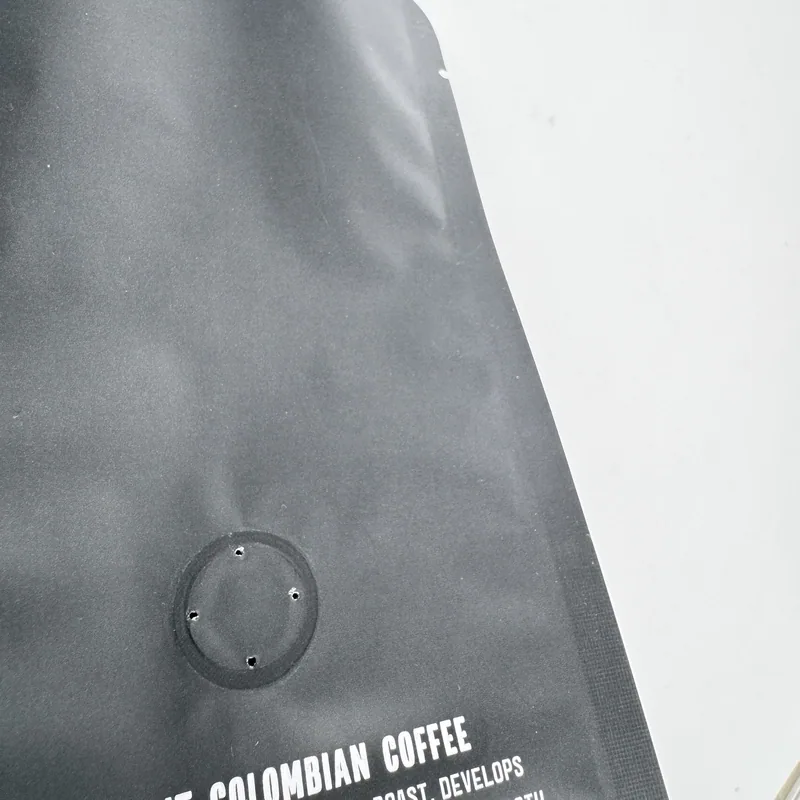
Coffee packaging material is where more first orders go wrong than anywhere else. Two bags can look identical on a shelf and behave completely differently six months later: one still smells like the roast, the other has gone flat. The difference is the laminate, not the artwork. This guide compares the four materials we actually run for coffee buyers - foil laminate, metallised film, kraft paper and compostable film - on the things that decide whether coffee survives the trip to the customer: barrier, shelf life, look and cost.
1. Why material, not artwork, decides shelf life
A coffee bag has three jobs: keep oxygen out, keep moisture balanced, and keep light off the aromatic oils. Roasted beans also release carbon dioxide for days after roasting, which is why a valve matters as much as the film. Material sets the ceiling on all three at once. You can print a beautiful bag on a weak film and it will still be flat coffee by the time it reaches the customer, which is why we treat the laminate as a shelf life decision rather than a design preference.
2. Inside a coffee bag: the three layers doing the work
Almost no coffee bag is a single film. It is a laminate, and each layer has exactly one job. When a quote comes back unusually cheap, the saving is nearly always in the middle layer.
The outer layer: print and protection
The outer layer is a print-carrying film, almost always polyester (PET). It protects the barrier layer below it from scuffing and moisture, and it is the surface that takes up to ten colours by gravure printing.
The middle layer: the barrier
The middle layer is the one that matters. Aluminium foil (AL) blocks oxygen, moisture and light at the same time; metallised film (VMPET) blocks light well and oxygen less well. This single layer is what separates a twelve-month shelf life from a six-week one.
The inner layer: the seal
The inner layer is the sealant, usually polyethylene (PE). It gives a clean heat seal that survives transit and keeps the pack food-safe for direct contact. It also decides whether a zipper or a valve can be welded in without leaking.
3. Foil laminate: PET/AL/PE
PET/AL/PE is the workhorse structure for coffee and the one we recommend for most export orders. The foil blocks oxygen, moisture and light at once, the inner PE gives a strong seal, and the outer PET carries full-colour print. Bags we run in this structure are rated for up to twelve months of shelf life, which is what lets you sell to distributors who hold stock rather than sell week by week. It is the structure behind our high barrier coffee bag. It is not the cheapest film on this list, and if your coffee turns over in weeks you are paying for barrier you do not need.
4. Metallised film: PET/VMPET/PE
Metallised film swaps the foil layer for a vacuum-deposited aluminium coating. It photographs almost as well, blocks light almost as well, and costs less per thousand. The trade-off is a lower oxygen barrier than true foil, so it suits whole bean and fast-turning retail packs rather than ground coffee carrying a long date.
5. Kraft paper: appearance first, barrier second
Kraft is what buyers ask for when the brand leans natural or organic, and it earns its place on the shelf. Be clear about one thing before you design around it: paper on its own is not a barrier. It has to be laminated to PE or foil, and the barrier you end up with is the barrier of whatever sits behind the paper. Printed kraft over a functional core is the usual compromise, which is how our kraft paper stand up pouch is built: a paper outer, a barrier inner.
6. Compostable film: certification before marketing
Compostable film is the fastest-moving category in coffee packaging and the one where expectations need managing. Barrier performance has improved a lot, but it still generally sits below a foil laminate, so the shelf life you can print on the pack is shorter. For an export buyer the real question is certification: ask for BPI or OK Compost, and ask whether the claim holds in home or only in industrial composting. Our compostable coffee bag is certified FDA, BPI and OK Compost, and we quote it with a realistic shelf life rather than the best case.
7. Matte, gloss and the finish question
Finish is a printing decision rather than a material one, but it changes the perceived value of the same laminate. Matte photographs better and hides fingerprints; gloss resists scuffing and makes colours pop; spot UV adds a raised contrast that reads as premium in the hand. A matte black coffee bag in a foil laminate is the combination specialty roasters ask for first.
8. Clear windows and transparent film
Transparent PET/PE film lets the buyer see the bean, which works for whole bean and for roasters who treat the product itself as the visual. The cost is barrier: a clear bag without a foil or metallised layer will not hold a long shelf life. When a window matters, the usual answer is a foil laminate with a small clear window rather than a fully transparent bag.
9. How to pick a material in one pass
Work backwards from the shelf life you promised your customer, not from the cheapest quote:
- 12 months, export and distribution: PET/AL/PE foil laminate
- 6 to 9 months, fast retail turnover: PET/VMPET/PE metallised film
- Weeks, local fresh trade: PET/PE clear film, or kraft over PE
- Sustainability is the positioning: compostable film with BPI or OK Compost, with the shelf life set honestly
If you are not sure which band you fall into, tell us the roast-to-shelf policy you sell on and we will pick the structure from that.
10. What material does to price and lead time
Material is one of the few cost levers that shows up in a quote immediately, and it interacts with quantity. Our printed coffee bags start at 1,000 pieces, negotiable for trial orders, and lead time runs 7 to 15 working days after sample confirmation, 10 to 15 for the multi-layer barrier structures. Certification holds across materials: FDA, ISO and SGS, with BPI and OK Compost added on compostable film.
11. Specifying material so your quotes compare
Send every supplier the same line: outer film, barrier layer, inner sealant, total thickness in microns, closure type, valve or no valve, print method, quantity and destination port. Quotes only compare when the specification behind them is identical, and the cheapest quote is usually a thinner barrier wearing the same name.
If you are still choosing between formats, start with our guide to choosing coffee packaging bags and come back here once the format is settled. Then look at the full range on our coffee packaging bags page, including flat bottom coffee bags and one way valve coffee bags. Send your fill weight, roast type and target shelf life through our contact form and we will recommend a structure and quote it.